
Vosoritide and Achondroplasia-Related Complications: New Data from Six Clinical Trials

A study published in Genetics in Medicine has examined the occurrence of achondroplasia-related complications in children and adolescents treated with vosoritide, comparing findings from six clinical trials with previously published natural history data.
The study, entitled Evaluating the impact of vosoritide on complications of achondroplasia, explores an important question in the long-term management of achondroplasia: beyond its effects on linear growth, could vosoritide also influence the development of complications associated with the condition?
Achondroplasia and complications throughout life
Achondroplasia is a genetic condition caused by a change in the FGFR3 gene, which affects bone growth. In addition to disproportionate short stature and other clinical features, achondroplasia is associated with several complications that may emerge or change over time, potentially requiring medical monitoring, surgical interventions and multidisciplinary care.
Figure 1 from the study provides an overview of the natural history of achondroplasia-related complications, illustrating how their occurrence and clinical significance vary with age:
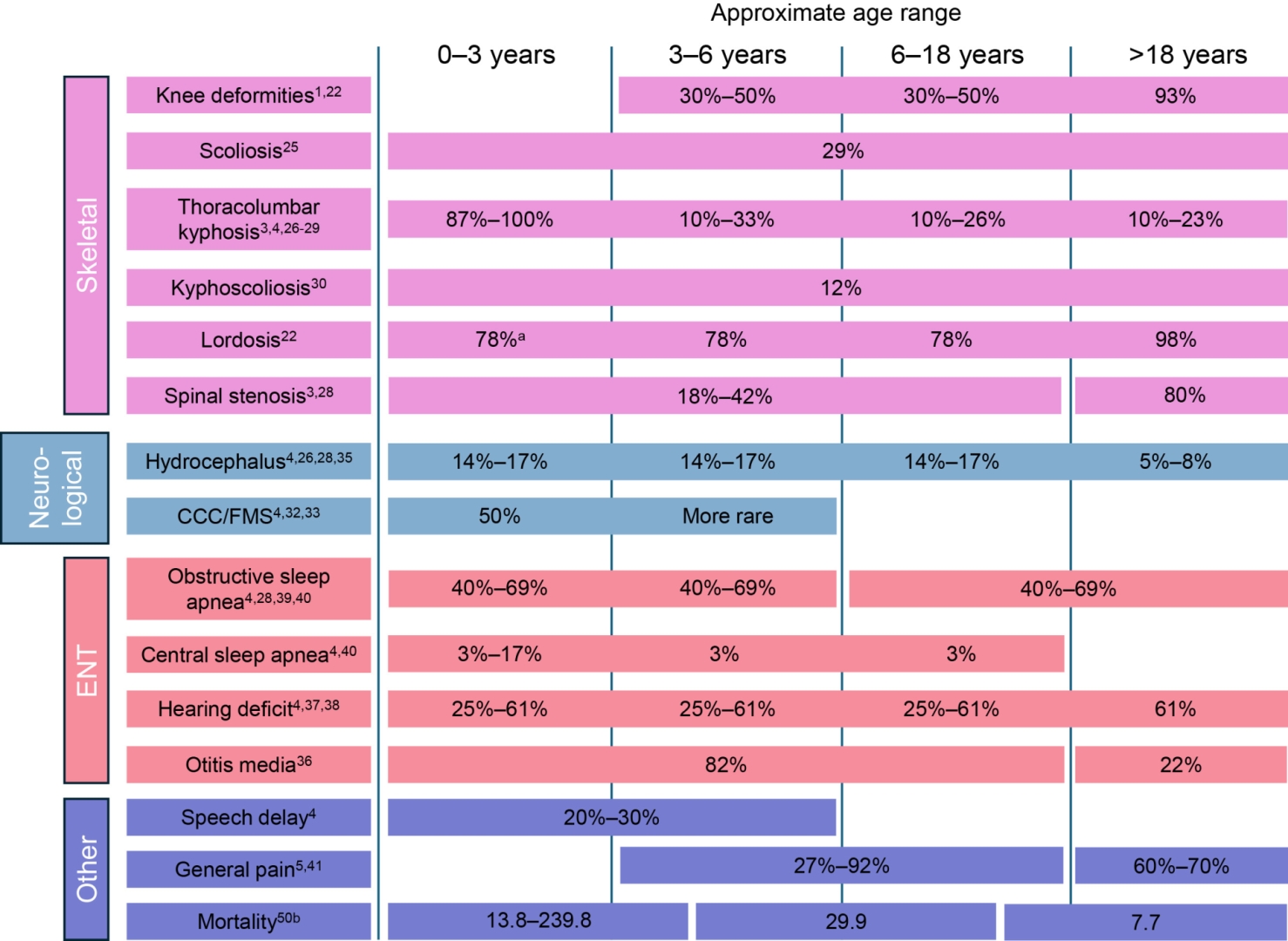
These complications include foramen magnum stenosis, which is particularly important during infancy and early childhood; respiratory and ear, nose and throat problems; lower limb alignment abnormalities; kyphosis; and spinal stenosis, which may become increasingly significant with age.
This highlights the importance of lifelong monitoring, as different complications may become more relevant at different stages of life.
What did the researchers investigate?
The researchers pooled data from six clinical trials of vosoritide, including participants who started treatment between 4 months and 18 years of age.
By 25 August 2024, 230 participants had received treatment. Of these, 68 had started treatment before the age of 5, while 162 had started at age 5 or older. The total treatment exposure amounted to 1,174.8 person-years, with a mean follow-up of approximately 5.1 years.
The analysis considered both the overall prevalence of complications, including those already present before treatment began, and their incidence after treatment initiation, including new events or worsening of pre-existing conditions.
What did the results show?
Overall, the prevalence of most complications among trial participants was similar to or lower than rates previously reported in the natural history of achondroplasia. Following treatment initiation, the incidence of several complications was also lower than rates reported in studies of untreated individuals.
The authors reported the following findings:
- Genu varum (bow-leggedness): an incidence of 3.5% after treatment initiation, compared with natural history estimates of 30–50%.
- Genu valgum (knock-knees): an incidence of 4.3%, compared with 11.5% reported in the literature.
- Lordosis: an incidence of 2.2%, compared with previously reported prevalence estimates of 78% in children and 98% in adults with achondroplasia.
- Spinal stenosis: an incidence of 6.5%, compared with natural history estimates of 17.9–42.3%.
- Hydrocephalus: an incidence of 0.4%, compared with previously reported estimates of 13.9–17.3%.
The study also examined surgical interventions. For lower limb deformities, 6.5% of participants underwent a procedure or surgery during the trial period, compared with estimates suggesting that approximately 20–25% of individuals with achondroplasia undergo such interventions over their lifetime.
Foramen magnum decompression was performed in 3.0% of participants overall. This proportion increased to 5.9% among those who started treatment before the age of 2. The authors also reported a lower crude mortality rate than that described in natural history studies.
What can we conclude — and what remains unknown?
The authors concluded that vosoritide was not associated with worsening of achondroplasia-related complications in the population studied. The findings also suggest that treatment may be associated with a lower frequency of some complications.
However, these results must be interpreted with caution. The clinical trials from which the data were drawn were not specifically designed to demonstrate that vosoritide prevents or reduces complications. Their primary objectives were to assess treatment safety and efficacy, rather than to formally evaluate its effects on individual complications.
Comparisons with natural history data also have limitations. Participants in clinical trials may differ from those included in historical studies in terms of age, clinical characteristics, follow-up duration and methods used to identify complications.
Furthermore, some children with more severe conditions were excluded from certain trials, particularly those considered likely to require surgery in the near future. This may have influenced the complication rates observed and limits the extent to which the findings can be generalised to all children with achondroplasia.
The authors emphasise the need for prospective studies specifically designed to investigate this question, involving larger populations, longer follow-up and, where possible, appropriate comparison groups.
A broader perspective on treatment outcomes
The importance of this study lies not only in the figures reported, but also in the broader question it raises. As treatments targeting the molecular mechanisms underlying achondroplasia become available, understanding their effects beyond linear growth is increasingly important.
Figure 1 helps place these findings in context by illustrating that achondroplasia-related complications are neither uniform nor static. Different health problems may emerge at different stages of life and have varying consequences for health, physical function and quality of life.
The newly published data add to the available evidence, but do not settle the question. Long-term monitoring of people receiving vosoritide will be essential to determine whether the differences observed in comparison with historical data translate into a sustained reduction in complications throughout life.
Reference
Savarirayan R, Hecht JT, Jayaram K, et al. Evaluating the impact of vosoritide on complications of achondroplasia. Genetics in Medicine. 2026;28(7):102584. DOI: 10.1016/j.gim.2026.102584.
The article is available open access in Genetics in Medicine: Read the full article.

